
About the procedure
After pregnancy and major weight loss, the abdominal skin sags and the abdominal muscles separate at the midline (diastasis). In a tummy tuck, excess skin is removed through an incision hidden along the bikini line, the muscles are brought together with sutures and the navel is relocated.
Liposuction of the waist and flanks is added for 360-degree contouring.
At the examination, the abdominal wall is assessed separately lying down and standing; the width of the muscle separation (diastasis) and any hernia are determined by palpation and, if needed, ultrasound. The incision location is drawn in advance according to the patient's preferred underwear line. To manage clot risk, compression devices are placed on the legs during surgery and blood thinner injections are planned according to the risk level.
- ✓A flat abdomen through muscle repair
- ✓Hidden incision along the bikini line
- ✓Can be combined with liposuction
Suitability
Who is it suitable for?
May be suitable
- ✓People with excess skin above and below the navel after pregnancy or weight loss.
- ✓Those whose abdomen protrudes because of separated abdominal muscles and does not improve with exercise.
- ✓People close to their target weight whose weight has been stable for at least 6 months.
- ✓Those who have completed their family and accept the restricted 6–8 week period after surgery.
Should be postponed or is not suitable
- —Those considering pregnancy in the near future; the muscle repair can come apart in a new pregnancy.
- —Patients with a high BMI who are still losing weight; weight stabilization is awaited first.
- —Those who continue to smoke; the risk of wound breakdown and tissue loss along the incision rises markedly.
- —Those with an uncontrolled chronic illness or a history of clots for whom a prevention plan cannot be made.
The final decision on suitability is made after a physician examination and tests.
Process
How does it proceed, step by step?
- 01
Initial consultation
Muscle separation, excess skin, and the tissue above the navel are assessed; whether a mini or full tummy tuck is needed is clarified.
- 02
Preparation
Blood tests and, if needed, internal medicine clearance are obtained; smoking is stopped 4 weeks beforehand and blood thinners are discontinued.
- 03
Surgery
Under general anesthesia, the skin is lifted through an incision along the bikini line, the muscles are sutured at the midline, excess skin is removed, and the navel is repositioned.
- 04
Hospital
You stay 1–2 nights; from the first day, walking slightly bent forward and leg movements are started.
- 05
Check-up
Drains are usually removed on days 2–5; the dressing and suture line are assessed.
- 06
Return and follow-up
Clearance to fly is given on days 8–10; remote photo check-ups continue at months 1, 3, and 6.
Recovery
Recovery timeline
Day 1
The abdomen feels tight; you walk slightly bent forward and sleep with a pillow under the knees. Pain is under control.
Days 3–5
Drains are removed and showering is cleared. Walks become more frequent; standing upright gradually becomes more comfortable.
Week 1
The garment is worn all day; the abdomen is supported when coughing. Heavy lifting is prohibited.
Weeks 2–3
You can walk fully upright and return to desk work. Swelling and numbness persist below the navel.
Weeks 6–8
The muscle repair reaches sufficient strength; exercise and heavy lifting begin with the physician's approval.
Month 6 – Year 1
Scar redness fades and numbness in the lower abdomen largely recedes; the final contour settles.
Timeframes are averages; they vary by person and by the scope of the procedure.
Results
Before / After
Published with patient consent. Results vary from person to person.
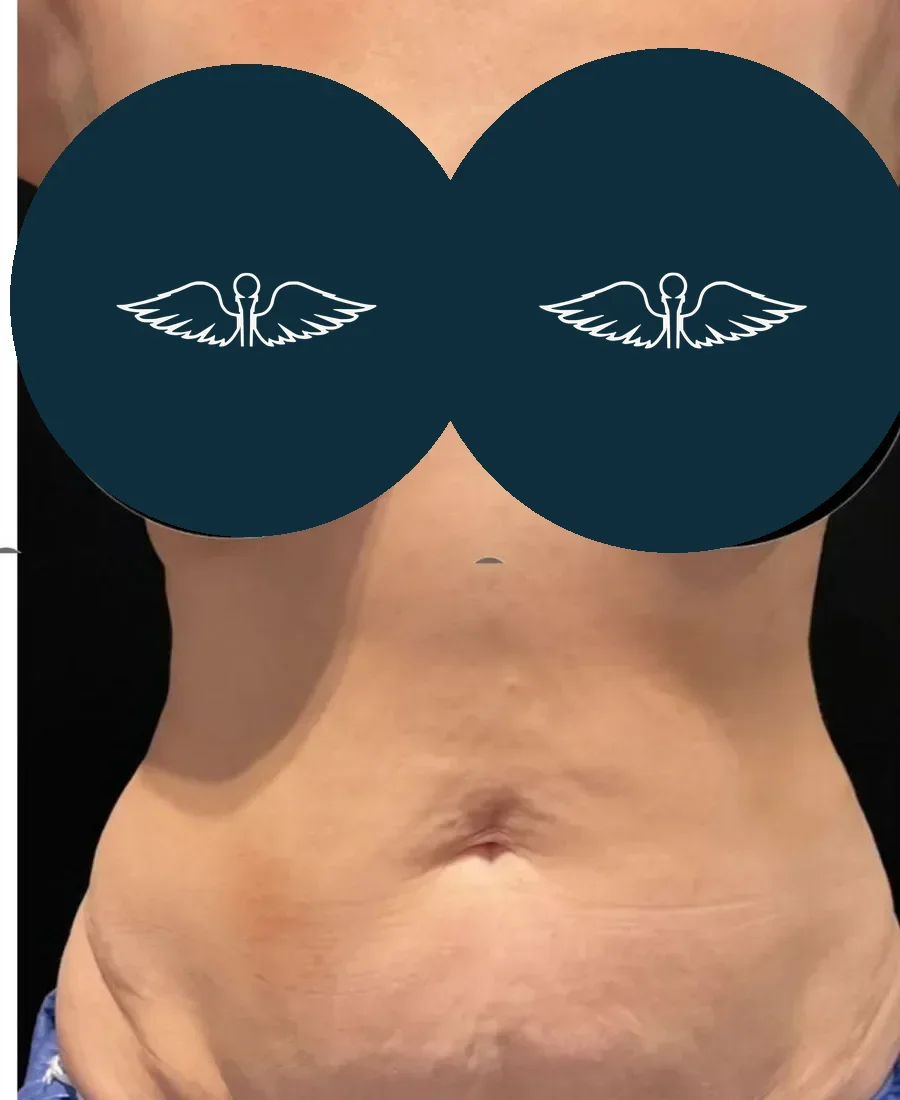 Before
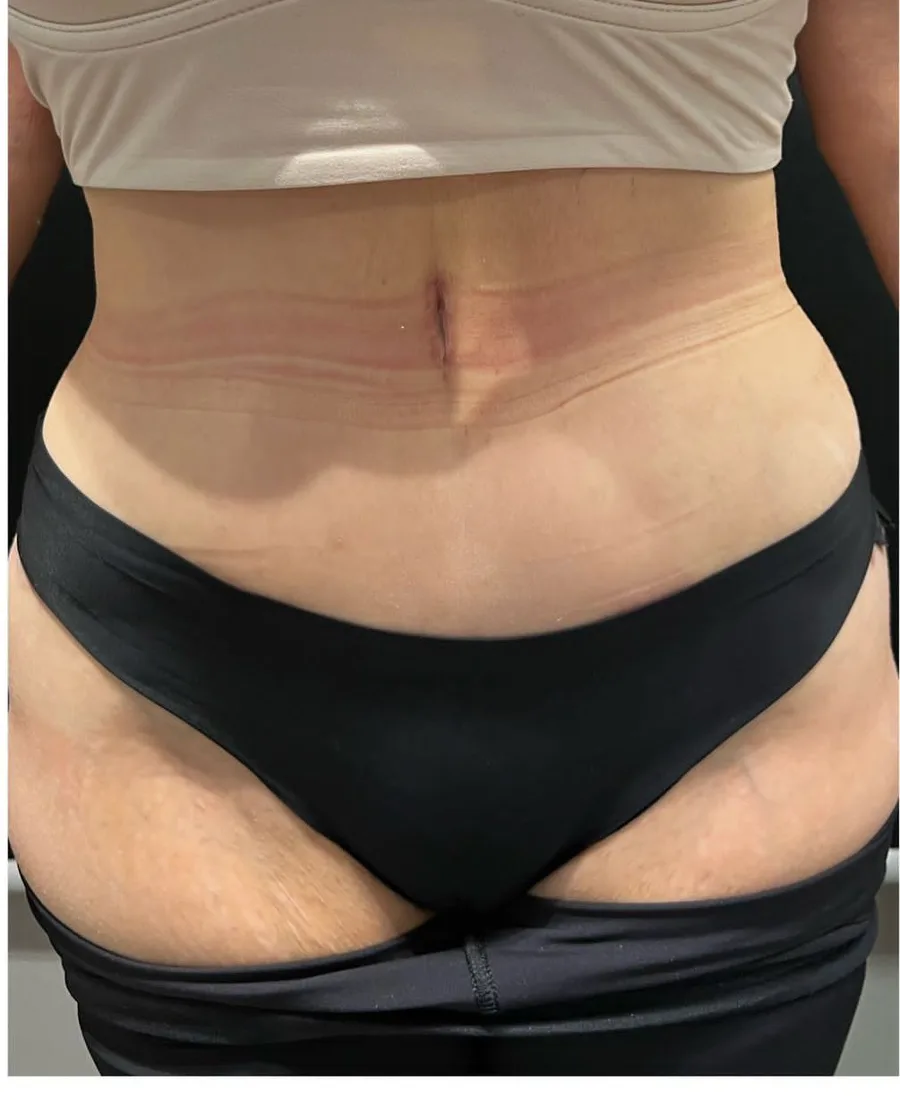 After
AfterLet us be open
Risks and points to consider
Every medical procedure carries risks. The points below are the main known issues for this procedure; a risk assessment specific to you is made during the consultation.
- Seroma and delayed wound healing along the incision; these are more common in smokers and at the most tightly closed midpoint of the incision.
- The scar healing thick, raised (hypertrophic), or asymmetric; scar care and, if needed, a minor correction are done.
- Dissatisfaction with the shape or position of the navel; rarely, the navel may have circulation problems.
- Deep vein thrombosis and pulmonary embolism; because this surgery is in the high-risk group for clots, preventive measures are standard.
- Prolonged reduced sensation in the lower abdomen, and excess skin at the ends of the incision (dog-ears) may remain.